
mandag 25. juli 2011

GRASS SNAKE (BUORM) SWIMMING IN A LOCAL POND


The first snake to come swimming past me.
D3s, 200-400 4,0, 400 mm, extension tubes, f6,3, 1/250, ISO 1600

OK, here comes "wild ideas about local snake photography, part 2" : I`ve had this wild idea (or should we say wet idea) for some time now : to try to do close ups on a grass snakes (buorm / Natrix natrix) swimming in its natural habitat : freshwater ponds. It may not sound like such a wild idea, but close ups on wild snakes with camera in water level is no easy match. I`ve been planning this continuously from early spring, finding possible locations etc. I also had to find a warm day to be sure to find the snakes the snakes in the water, a day with absolutely no wind to support the reflections in the water that I wanted, and preferably a day with good lighting conditions with no direct sunshine. I also realized that I would have to get down there myself, literally submerged in the marshy, muddy pond with all its plentiful of "Alice in Wonderland-creatures" !!!!.... and, by using a wetsuit, stay down there for quite a long time. This is the easy part. The easy part is also to place my camera with the 200-400 lens with extension tubes on a plate of XPS, floating just above the water level to give that extremely low level in eye-hight with the snakes. The hard part is to make a snake swim by at a suitable range!

PS : I am probably the first human to be swimming around in that pond. And I had to try several times as well. Luckily the neighbours didn`t see me !!

Again : Thanks to Paal !!!
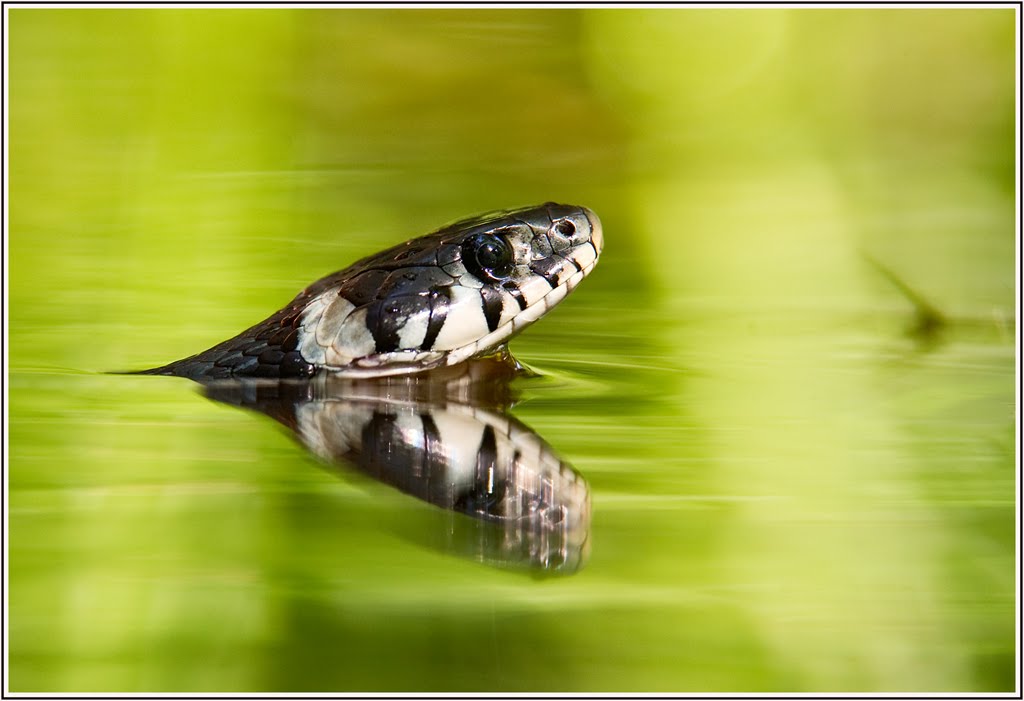

After a dive the snake suddenly pops up with only the head visible on the green waters surface
D3s, 200-400 4,0, 400 mm, extension tubes, f6,3, 1/200, ISO 1600


Obviously suspicious on my presence
D3s, 200-400 4,0, 400 mm, f6,3, extension tubes, 1/500, -0,67, ISO 1600


Smelling me !!
D3s, 200-400 4,0, 400 mm, extension tubes, f6,3, 1/200, ISO 1600


Disappearing in the spooky Amazon-jungle...
D3s, 200-400 4,0, 400 mm, extension tubes, f6,3, 1/640, -0,67, ISO 1600


D3s, 200-400 4,0, 400 mm, extension tubes, f6,3, 1/250, -0,67, ISO 1600


Continuously smelling me
D3s, 200-400 4,0, 400 mm, extension tubes, f6,3, 1/1000, -0,67, ISO 1600


As the snake is exposed in direct sunshine, heavy underexposing gives the black background
D3s, 200-400 4,0, 400 mm, extension tubes, f6,3, 1/2000, -0,67, ISO 1600

lørdag 16. juli 2011

VIPER SWALLOWING A PREY


Viper smelling it`s way to the dead mouse
D3s, 105 mm micro 2,8, fill in flash 2 stk SB-R200, f13,0, 1/50, -1,0, ISO 800

As I was fortunate to do my closeup photography on all three recident species of snakes in Norway (check out blog from May), I actually had two "wild ideas" about pushing the limits on my work with these species. One of these ideas was to document the common viper (Vipera berus / huggorm) swallow a prey. This has to my knowledge hardly been done before (if you know otherwise : please let me know), although my childhood hero photographer and biologist Per Hafslund presented a picture of a viper swallowing a frog..... some time back in the sixties. The reasons for this is obvious : the viper is a shy animal, this is of course a situation you just don`t stumble into and get in position to shoot and, ... most important : the viper is known not to take food in captivity.

Knowing that these animals are protected by law, I took myself the liberty to "borrow" a big female for a limited period of time. I named the lady Hanne Hugh and worked with her continuously to make her accept my sounds and careful movements. . Natural food for vipers are mice, and mousetraps were active in the nearby forest to "fill the deep freezer".. It`s long and complicated story, but the short version is as follows :

A dead mouse was collected in the freezer and melted to room temperature. However, it was considered essential to warm the mouse to "live / living" temperature. Using the microwave oven in the kitchen seemed like an obvious solution, ... but my wife refused it !!! OK; plan B : the hairdryer came in handy for the purpose. The warm mouse was then held in continuous motion in front of the snake.... and it worked !!! She stroke ! She opened her jaws to 180 degrees and in a glimpse inserted her long fangs into the dead mouse. Twice !!

Now, what happens next in nature is that the viper lets the mouse run away (if holding it she might risk an injury from a mousebite), the mouse however quickly dies and the snake tracks it down by smell. Same thing was done here : the dead mouse was pulled / dragged along the moss leaving a track of smell and put in position for pictures.

Waiting ! Minutes felt like hours. I was afraid the snake might hear my heartbeats ! Nothing happened. I was starting to get that good old failure-feeling. Finally she started smelling and locating the prey. The rest is documented in the pictures.

Controlled situation ? Yes, of course, .... and I am proud of this work.

As always when it comes to local "snakery" : a warm thank you to my friend Paal. Without his knowledge and experience this would not have been possible.

PS : The lady is now back where she came from, happy and well fed !!

PS : The other "wild idea" about local snake photography ? Coming soon !!

PS : Sorry for writing so long. Next time I`ll be shorter !!


After curling up around the prey the viper has located the head a the mouse (Yellownecked mouse / Stor skogmus) and starts the swallowing process.
D3s, 105 mm micro 2,8, fill in flash SB900, f16,0, 1/60, ISO 1600


Prey : Bank vole / klatremus
D3s, 105 mm micro 2,8, fill in flash SB900, f16,0, 1/160, -1,0, ISO 2000


Prey : Bank vole / klatremus
D3s, 105 mm micro 2,8, fill in flash SB900, f16,0, 1/100, -0,33, ISO 2000


Prey : Yellownecked mouse / Stor skogmus
D3s, 105 mm micro 2,8, fill in flash SB900, f16,0, 1/80, ISO 1600


Prey : Bank vole / klatremus
D3s, 105 mm micro 2,8, fill in flash 2 stk SB-R200, f11,0, 1/50, -1,00, ISO 800


Prey : Bank vole / klatremus
D3s, 105 mm micro 2,8, fill in flash SB900, f16,0, 1/80, -0,33, ISO 2000


Prey : Bank vole / klatremus
D3s, 105 mm micro 2,8, fill in flash SB900, f16,0, 1/80, -0,33, ISO 2000


The viper is wringing her jaws to get them back in position as the mouse disappears in "the dark"
D3s, 105 mm micro 2,8, fill in flash SB900, f 16,0, 1/80, -0,33, ISO 2000


Prey : Yellownecked mouse / stor skogmus
D3s, 105 mm micro 2,8, fill in flash SB900, f 16,0, 1/40, ISO 1600


Prey : Yellownecked mouse / stor skogmus
D3s,m 105 mm micro 2,8, fill in flash SB900, f16,0, 1/50, ISO 1600


Prey : Bank vole / klatremus
D3s, 105 mm micro 2,8, fill in flash SB900, f16,0, 1/60, -0,33, ISO 2000


The last hair on tip of the mouse-tail disappears...
D3s, 105 mm micro 2,8, fill in flash SB900, f16,0, 1/50, -0,33, ISO 2000

mandag 4. juli 2011

INTERMISSION BLOG NO 2 : HAPPY SUMMER


I have a great photographic summer, many projects and I have (in my own opinion !!) great results ! I am honestly quite proud of some of this stuff. However : I don`t have the time so far to work with the files, .....and besides : who is checking out blogspots in mid summer ???
So, I`ll blog this later.... when all you guys are back from holiday.

I hope you have a great summer !!

The pictures are from a pond in a forest river and is basicly showing : foam.


onsdag 22. juni 2011

MEET DRACULA !!


Dracula himself !
D3s, 200-400 4,0, f4,0, 0,3 sec, -1,67, ISO 3200

(English summary at the rare end)

Hubro er for meg noe av det mest spennende og mytiske av alle fugler her hjemme,.....men også fotografisk "uoppnåelig" fordi den er svært sjelden og 100 % nattaktiv. Jeg hadde sett hubro 3 ganger før i mitt liv, alle på Helgelandskysten på mer enn 50 m hold. Takket være et langsiktig arbeide utført av noen venner vestpå, fikk jeg tilbringe 2 døgn i kamuflasje medbringende en bærepose med døde høns og kråker. Jeg fikk vite at fuglene (hr & fru Dracula) ofte dukka opp ved 1/2 12-tida på natta og ble i beste fall ut i grålysningen på morgenen. Jeg rigget opp en haug av fjernstyrte blitzer og gikk optimistisk inn i skjulet ved 20 tida. Det var en dyster og våt kveld med mye vind, og mørket la seg etterhvert som en diffus, blå dyne over kystlandskapet. Klokka ble 11, halv 12, 12, halv 1, ingen hubro. Jeg kjente smaken av nedtur i munnvikene, og håpet dalte. Jeg måtte pisse. Mørket var totalt. Å tenne hodelykt var selvfølgelig uaktuelt. Alle som har prøvd å pisse på ei vindusspyle-kanne i mørket vet at dette krever full konsentrasjon... og to hender. Midt under Niagara Falls kaster jeg et sideblikk ut på svaberget, og ..... der sitter den jo !! Den kom selvfølgelig lydløst og umerkelig, bare satt der plutselig, som en svart, urørlig silhuett mot det mørke, dystre havet. Den så faenmeg streng ut !! Jeg assosierte både Dracula og Gamle Erik på èn gang ! Den mangla riktignok ljåen, men øreduskene gjorde samme nytten. . Jeg kan forstå hvorfor fuglen i mange kulturer er blitt knytta opp mot underjordiske krefter.

Fotograferiga var krevende. Autofokus var nytteløst og manuell fokus nesten umulig i mørket. Utgangspunktet for eksponeringene var å unngå det typiske blitzbildet med opplyst forgrunn og svart bakgrunn. Håpet var at lang lukkertid (ofte mer enn 1 sek) og et kort blitzflash skulle gi både dybde i bildet og skarp fugl. Med kuling i vindkastene var det imidlertid altfor mye bevegelse i fjær og "ører", noe som vises på bildene. Natt nr 2 ble ennå våtere enn den første. Jeg kunne vært heldigere med været, men pytt : det var uansett en opplevelse for livet !
Derfor : Tusen takk til "Gudfaren" og hans to kamerater for at jeg fikk slippe til.

Brukte dagen i et mårskjul uten at måren dukka opp. Jeg sov tilsammen 4 timer på 2 døgn..... og satte meg deretter i bilen og kjørte 8 timer hjem. Red Bull virker !!!


D3s, 200-400 4,0, f4,0, 0,5 sek, ISO 2000, 2 flashlights


D3s, 200-400 4,0, f4,0, 1,3 sek, ISO 2000, 2 flashlights


Male bird
D3s, 200-400 4,0, f4,0, 0,8 sek, ISO 3200, 2 flashlights


Male bird calling for female
D3s, 200-400 4,0, f4,0, 1,3 sek, ISO 3200, 2 flashlights


Male bird calling for female
D3s, 600 4,0, f4,0, 0,8 sek, ISO 3200, 1 flashlight


Female bird swallowing a huge soft bite of the chicken
D3S, 200-400 4,0, f4,0, ISO 3200, 2 flashlights.


Eagle owl attacking the carcass of the crow
D3s, 200-400 4,0, 0,8 sek, ISO 3200, 2 flashlights


Female bird, dripping wet !
D3s, 200-400 4,0, f4,0, 0,8 sek, ISO 3200, 2 flashlights


Dawn supplies a little bit of natural light.
D3s, 600 4,0, f4,0, 1/10, ISO 3200, 1 flashlight


D3s, 600 4,0, f4,0, 1/40, ISO 3200, 2 flashlights


D3s, 600 4,0, f4,0, 1/30, ISO 3200, 2 flashlights.


D3s, 200-400 4,0, f4,0, 1/50, ISO 3200, 2 flashlights.


D3s, 200-400 4,0, f4,0, 1/25, ISO 3200, 2 flashlights


Eagle owl landscape with passing boat
D3s, 200-400 4,0, f4,0, 1,0 sek, ISO 3200, 2 flashlights

English summary : The pictures of the rare eagle owl were taken during 2 rainy nights along the coast of western Norway. This huge owl with wingspan up to 1,8 m is completely nocturnal and shooting the photos was a real challenge due to the lack of natural light. To supply a little depth in the motives I used exposures of more than 1 sec, supplied with several flashlights to (hopefully) secure a sharp owl. However the heavy wind gave too much movement in the feathers. Anyway : A great experience !!

torsdag 16. juni 2011

INTERMISSION BLOG NO 1 : WILDLIFE AT SAMOS

The 20 mm "flower-fly"
D3s, 105 mm micro 2,8, f11,0, 1/640, ISO 800, handheld

I am working at some ambitious projects, but they take som time !! In the meanwhile I give you an "intermission blog".

They tell me that wildlife photographers sometimes can be a bit of a challange to be married to. Although I completely disagree with such a pompous statement, .....I actually agreed to go one week with my wife to the Greek island Samos in "Operation Save the marriage 2011" !! She made me promise not to bring any cameras (!!!!!), .....this is why I only brought some basic stuff like a camera house (only one !!!), the 200-400 mm, 105 mm micro, 2 x converter, bellows, flashlight ... and a simple monopod !!

Samos have some wonderful green salads and ditto retzina.

Visible wildlife is ......basicly insects.

The 20 mm "flower-fly"
D3s, 105 mm micro, f 11,0. 1/640, , ISO 800 , handheld

Butterfly
D3s, 105 mm micro 2,8 + 2,0 x converter, f 8,0. 1/500, ISO 800, handheld

Butterfly
D3s, 105 mm micro 2,8 + 2 x converter, f 8,0, 1/800, ISO 800, handheld

Dragonfly : Calopteryx
D3s, 200-400 f4,0, bellows, f5,6, 1/1250, ISO 1600, monopod

Dragonfly : Calopteryx
D3s, 200-400 f4,0, bellows, f5,6, 1/1000, ISO 1600, monopod

Dragonfly (Aeschna ??)
D3s, 200-400 4,0, bellows, f 5,6, 1/400, ISO 1600, monopod.

Roadkill of Caspian whipsnake, the biggest snake in Europe. This one is close to 2,0 m.
Panasonic Lumix 2,0, f5,6, 1/500, ISO 80, handheld

Caspian whipsnake : Roadkill
Panasonic Lumix 2,0, f5,6, 1/640, ISO 80, handheld.

Swallow on nest
D3s, 200-400 f4,0, f11,0, flash, 1/160, ISO 1600, -0,33.

Five "no-mercy chickens" in the swallow nest
D3s, 200-400 f4,0, f11,0, flash, ISO 2000, -2,0.

Wildlife photography at Samos !!!

PS : I`m still married !!!